
The Augustana Ministerium
A pastoral association formed to preserve and promote Lutheran pastors and a distinctively Lutheran Ministry of Word and Sacrament to Lutheran congregations
Latest Announcement
Revitalizing the Augustana Ministerium
Dear fellow servants of our Lord Jesus Christ in the Office of the Holy Ministry:
Greetings in the Name of our Risen and Ascended Lord!
Many years ago, a number of faithful confessional Lutheran Pastors formed the Confessional Lutheran Ministerium, later known as the Augustana Ministerium. It is a fantastic organization, but its actions haven’t received a lot of attention in recent years. Among the things the Augustana Ministerium has done:
Annual conferences were held, wherein theological papers were presented which, at least in my experience, were far more theologically edifying than what I was finding at the official gatherings of my former church body. These conferences were genuine “free conferences” such as Lutherans had engaged in a century earlier…no pressure to overlook theological differences…just a venue to have honest theological discussions with fellow Lutheran pastors (whether we were in a state of altar and pulpit fellowship with each other or not!), striving to be faithful to the Lord, the Scriptures and the Lutheran Confessions, and encouraging one another toward that end. We sought to recruit young men to study for the holy ministry. Our Dean of Pastoral Care provides care for those pastors in physically, financially or spiritually challenging circumstances. We receive donations, and support men who found themselves struggling to make ends meet, often as a consequence of the very faithfulness we sought to encourage.
For the last few years, the Augustana Ministerium may have seemed “dormant,” but we never stopped engaging in the collection of donations and aiding needy pastors. (In fact, to date we have provided $289,971 in various forms of assistance). We did, however, stop collecting dues and having annual conferences.
The time has come to re-engage. Faithful confessional Lutheran pastors are “under the gun” now more than ever, and the network of confessional Lutheran conferences seems to have gradually faded away to the point that young pastors may have no idea where to turn for support. The culture in which we live is becoming increasingly hostile even to basic Christian belief and morality. We need the opportunity to come together and encourage one another. And plenty of men need the pastoral care and sometimes the financial help that we once provided.
If you have received this letter, it is because you once were a member of the Augustana Ministerium, or because someone on the administrative council thought you might wish to become one. Here is what I am inviting you to do:
1. Re-read the constitution and the statement on the ministry. Assuming you agree…
2. Send your annual dues of $50.00 to either via PayPal to TAMBursar@gmail.com or by check to:
The Augustana Ministerium
c/o Rev. Anthony Oncken, interim Bursar
712 Brandt St. Grandview, TX 76050
3. Save October 18 of 2023 (the Festival of St. Luke) as the date of our annual conference. We will gather at Cross of Christ Lutheran Church in DeSoto, TX, where Pastor John DeYoung has graciously welcomed us to gather. (DeSoto is not far from both DFW and Love Field airports.)
I thank you for your faithfulness, for all that you have done in the past, and I look forward to all the Lord will have use of us to do in the future as we re-engage this God pleasing work.
Yours in service to Christ Jesus,
The Rev. Fr. Kent A. Heimbigner, Ph.D.
Legate of the Augustana Ministerium
News and Updates
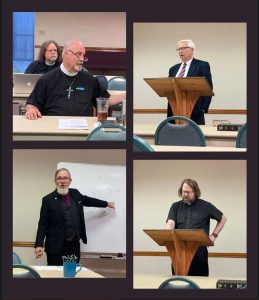
Highlights from the 2023 Conference
We had an excellent conference at Cross of Christ Lutheran Church (LCMS) on 18.October.2023. Rev. Andrew Eckert spoke on the ongoing need for Pastoral care
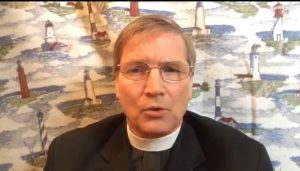
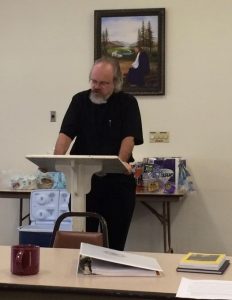
Highlights from the 2017 Theological Conference
The Reverend Kent Heimbigner, Ph.D., Pastor of Charity Lutheran Church of Burleson, Texas, delivers his paper, “Reformation Insights into the Marks of Lutheran Education.” The